


Description
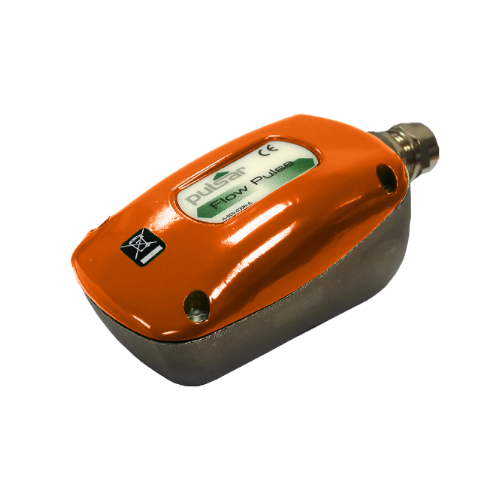
FlowPulse
Clamp-on flow monitor


We are Exclusive Partner
Specifications
| Physical | |
|---|---|
| Sensor housing dimensions | 120 mm x 65 mm x 65 mm (4.8 inch x 2.6 inch x 2.6 inch) |
| Weight | Nominal 1.5 kg (3.3 lb) |
| Housing material/description | Cast stainless steel type 316 |
| Cable entry | 1 x M20 x 1.5 mm (0.06 inch) cable gland |
| Maximum separation | Up to 500 m (1640 ft) |
| Environmental | |
| IP rating | IP68 (optional sensor versions can be supplied with factory-moulded cable) |
| Max. & min. temperature (electronics) | -20 °C to +70 °C (-4 °F to +158 °F) |
| CE approval | Listed in the certificate of conformity within the manual |
| Performance | |
| Accuracy/repeatability | ±5% typical, depending on installation and pipe conditions |
| Resolution | 3 mm/s (0.1 inch/s) |
| Velocity range |
• 300 mm/s to 4 m/s (11.8 inch/s to 13.1 ft/s) standard version, or • 300 mm/s to 10 m/s (11.8 inch/s to 32.8 ft/s) high-flow version |
| Response time | Fully adjustable (minimum 1 second) |
| Minimum particle size | >100 μm |
| Minimum particle concentration | >200 ppm |
| Pipe diameter |
• V1: 30 mm to 350 mm (1.2 inch to 14 inch), or • V2: 30 mm to 1.3 m (1.2 inch to 4.1 ft), or • V3: up to 2 m (6.6 ft) |
| Pipe wall thickness | Metal or rigid pipe up to 20 mm (0.8 inch) thick |
| Signal processing | RSSA (Refracted Spread Spectrum Analysis) |
| Outputs | |
| Analogue output | 4-20mA into a 1 kΩ load (at supply voltage of 22 V DC or higher) with 20 μA resolution and user-programmable span |
| Digital output | Full Duplex RS232 to PC Software, Half Duplex RS485 to PC Software, Half Duplex RS485 with Modbus RTU |
| Volt-free contacts, number and rating | 1 form “C” (SPDT) rated at 1 A at 24 V DC |
| Programming | |
| PC programming | Via RS232 or RS485 with Flow Pulse PC |
| Programmed data integrity | Via non-volatile RAM |
| Power Supply | |
| Supply voltage | 18-28 V DC |
| Power consumption | 2.4 W at 24 V typical, 3 W at 24 V maximum |
Communication

Product Overview
Technology & Features

How does it work?
Ultrasonic sound is fired at a 90-degree angle to the flow through the pipe wall via a tangentially mounted high-output ceramic transducer. The sound is then refracted at various angles across the flow axis and reflected by bubbles, particles, and vortices in all directions and over a wide frequency range. The wide, refracted ultrasonic beam maximizes the ultrasonic energy captured from flowing particles. These multiple reflections are received back into the unit via a second high-quality ceramic transducer.
Does this work for clean or dirty water?
Due to its Doppler technology, the FlowPulse works best in applications with many bubbles, particles, or vortices; in other words, dirty water.
For clean water, the Pulsar TTFM 6.1 from Pulsar Measurement is better suited. Check our website or the product information for more details.
Would you like more information about the different ultrasonic techniques you can use before making a choice?

Return Signal Analysis
The return signal is analyzed using FlowPulse’s Refracted Spread Spectrum Analysis (RSSA) digital signal processing to obtain flow information. RSSA views and combines the signals over a wide frequency range and splits them for real-time analysis and flow calculation.

This digital platform ensures strong repeatability of measurements and can be adapted to the application. For example, functions such as damping and response time can be easily adjusted.
FlowPulse Measuring Range & Pipe Requirements
The FlowPulse operates at a flow rate of 300 mm/s to 10 m/s (11.8 in/s to 32.8 ft/s). The minimum particle size is 100 µm and the concentration must be 200 ppm or higher (such as hard water). Pipe materials can include: rigid plastic, stainless steel, mild steel, or cast iron. Corrugated pipes are no problem, as long as the silicone pad fills the irregularities.

Options
The FlowPulse works standalone and requires 18-28 V DC. The sensor has a programmable relay, a scalable 4-20mA output proportional to the flow rate, and connects to a PC via RS232. A Modbus RTU RS485 output is also available for integration with other systems or connection to the Flow Monitor controller from Pulsar for remote display and additional outputs.
Looking for something else?
Optional accessories include the Flow Monitor for fixed installation and the FlowPulse Handheld Controller for portable measurements. Alternatives such as the Pulsar DFM 6.1 and Pulsar PDFM 6.1 are also suitable for Doppler flow measurement in pipes. See the website or brochures for more information.


In Practice
A pumping station needed to improve its efficiency. It was crucial to identify problems within the infrastructure. Using the Quantum 3 pump controller from Pulsar Measurement and three FlowPulse sensors, the controller could display the changing sewage levels and flow rates. Three identical pumps were installed, and the controller rotated between pumps each cycle. When it was pump 3’s turn, the flow rate was different – more than a 20% difference compared to the other pumps! The staff already suspected a problem with a non-return valve, and the FlowPulse proved this was correct. FlowPulse can be used for many applications, such as monitoring pump efficiency, standalone or as part of a complete pump control system. It adds a vital dimension to site control: diagnostic flow measurement.
Application(s)
Measurement of dirty and difficult liquids
This is the core area of application. Unlike many other ultrasonic meters (which require clean liquids), the FlowPulse is specifically designed for liquids containing particles, air bubbles, or vortices. The meter uses reflections from these impurities to calculate flow velocity.
Wastewater treatment and sewage transport
Due to its suitability for liquids with solids and its non-invasive design, the FlowPulse is widely used in water treatment plants and for monitoring wastewater flows and sewage transport lines. No service interruption or pipe intervention is required, minimizing costs and risks.
Pump and process efficiency monitoring
The monitor is ideal for checking the performance and efficiency of pumps and other industrial processes. By measuring the flow, one can quickly detect issues such as excessive air entrainment, which affects pump efficiency.
Process Industry
Measure flow in existing installations without interrupting production or risking leakage with aggressive media.
Temporary Measurements and Validation
Thanks to its simple and fast installation (with a single screwdriver), the FlowPulse can be deployed as a portable unit in combination with a handheld controller. This is ideal for:
-
- Rapid measurements and troubleshooting.
- Validating the measurements of fixed, inline flowmeters.
Various pipe materials and diameters
The sensor works reliably on a wide range of pipe materials, including rigid plastic, stainless steel, cast iron, and even corrugated pipes. This makes the FlowPulse highly flexible for installation in existing infrastructure.